

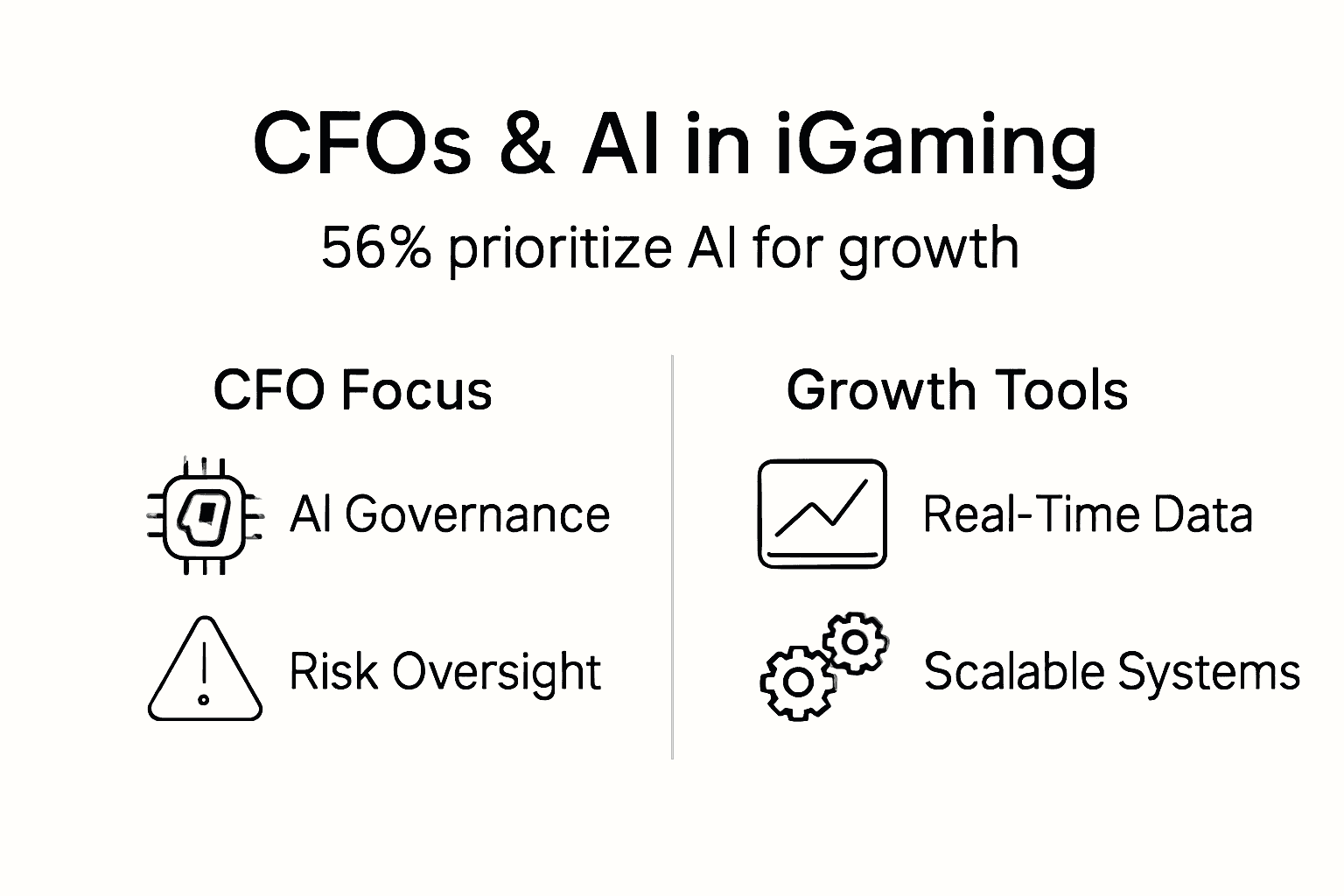
Think CFOs in iGaming just crunch numbers and sign off on compliance reports? That outdated view ignores the reality of 2026, where more than 56% of iGaming operators now prioritize CFO-led AI financial integration to drive scalable growth. Today's iGaming CFOs are strategic architects navigating multi-jurisdictional regulations, leading technology transformation, and allocating capital across volatile markets. This guide reveals how the CFO role has evolved into a critical leadership position balancing compliance complexity, operational scalability, and investor confidence in Europe's dynamic iGaming landscape.
Table of Contents
- Introduction To The CFO's Role In iGaming
- Core CFO Responsibilities In iGaming
- The Evolving Strategic Role Of The CFO In iGaming
- Financial Strategy For Growth And Scalability
- Compliance And Risk Management In iGaming
- Investor Relations And Compliance Communication
- Common Misconceptions About The CFO Role In iGaming
- Conclusion: Advancing The CFO Role For Future iGaming Success
- Discover Expert CFO Services Tailored For iGaming Growth
Key takeaways
| Point | Details |
|---|---|
| Multi-jurisdiction complexity | CFOs manage compliance and reporting across diverse European and global regulatory frameworks simultaneously. |
| AI integration leadership | Over 56% of iGaming operators now prioritize CFO-led AI adoption to optimize financial operations and forecasting. |
| Strategic capital allocation | CFO-driven resource deployment balances innovation investment, compliance costs, and market expansion priorities. |
| Investor relations centrality | Transparent communication of regulatory risks and growth prospects by CFOs builds essential capital access and trust. |
| Expanded strategic mandate | Modern CFOs lead digital transformation, technology governance, and enterprise-wide strategic initiatives beyond traditional finance. |
Introduction to the CFO's role in iGaming
The European iGaming sector has experienced explosive growth, with operators expanding rapidly across multiple jurisdictions while navigating an increasingly complex regulatory patchwork. Malta, the UK, Sweden, and emerging markets each impose distinct licensing requirements, reporting standards, and operational constraints. This regulatory plurality creates unique demands on finance leadership that extend far beyond traditional CFO responsibilities.
CFOs in the iGaming sector are increasingly required to lead global financial strategies managing multi-jurisdictional reporting and compliance across diverse regulatory environments. The role now encompasses:
- Financial stewardship coordinating consolidated reporting under IFRS and jurisdiction-specific standards
- Strategic planning that accounts for market volatility, player behavior shifts, and regulatory changes
- Compliance oversight ensuring adherence to licensing conditions across all operating territories
- Technology integration decisions affecting financial systems, data infrastructure, and operational efficiency
- Capital allocation balancing growth investment, compliance costs, and shareholder returns
Technology amplifies complexity. Payment processing spans multiple currencies and regulatory frameworks. Player data must meet GDPR and local privacy laws. Real-time financial monitoring becomes essential when operations run 24/7 across time zones. CFOs must architect systems and controls that scale with growth while maintaining audit readiness and regulatory compliance in every jurisdiction.
Core CFO responsibilities in iGaming
Managing multi-jurisdictional reporting requirements represents perhaps the most demanding aspect of the iGaming CFO role. Each market imposes unique financial disclosure obligations, tax treatments, and compliance attestations. CFOs must consolidate financial results while maintaining jurisdiction-specific reporting that satisfies local regulators, tax authorities, and licensing bodies.
Financial planning in iGaming requires techniques adapted to rapid market shifts and seasonal volatility. Player acquisition costs fluctuate with marketing effectiveness and competitive dynamics. Regulatory changes can suddenly alter operational economics. CFOs develop scenario-based forecasting models that incorporate regulatory risk, market expansion timelines, and technology investment cycles.
Effective CFOs implement robust internal controls and compliance frameworks specifically tailored to iGaming's complex multi-market regulatory requirements, significantly reducing risk of penalties. Key control areas include:
- Transaction monitoring systems that flag suspicious activity and ensure responsible gaming compliance
- Segregation of duties protecting player funds and preventing fraud
- Automated reconciliation processes handling high transaction volumes across multiple platforms
- Documentation standards meeting IFRS, SOX, and jurisdiction-specific audit requirements
- Regular internal audits verifying control effectiveness and compliance adherence
Coordination with compliance and legal teams becomes critical. CFOs work closely with General Counsel to interpret regulatory guidance, assess new market entry risks, and structure operations to minimize compliance exposure. This collaboration ensures financial strategies align with regulatory realities rather than creating avoidable conflicts.
| Responsibility Area | Key Activities | Regulatory Drivers |
|---|---|---|
| Multi-jurisdiction Reporting | Consolidated financials, local disclosures, tax filings | IFRS, local GAAP, tax codes |
| Internal Controls | Transaction monitoring, fund segregation, audit trails | SOX, licensing conditions |
| Compliance Coordination | Regulatory interpretation, risk assessment, audit support | MGA, UKGC, local authorities |
| Financial Planning | Scenario modeling, capital allocation, cash flow management | Market volatility, growth targets |
The strategic CFO services in iGaming landscape requires sophisticated technical expertise combined with deep regulatory knowledge to navigate these interconnected responsibilities effectively.
The evolving strategic role of the CFO in iGaming
The modern CFO role extends beyond traditional finance into strategic enterprise leadership, requiring skills in AI oversight, data analytics, and digital transformation relevant to iGaming growth. Technology adoption has become a strategic imperative, with CFOs leading evaluation and governance of transformative tools.
AI integration offers powerful capabilities for financial forecasting, fraud detection, and operational optimization. CFOs must assess vendor solutions, establish implementation roadmaps, and create governance frameworks ensuring ethical and effective AI deployment. This includes:
- Evaluating AI tools for financial close automation, forecasting accuracy, and anomaly detection
- Establishing data quality standards and model validation processes
- Defining approval workflows and human oversight requirements for AI-driven decisions
- Monitoring AI performance metrics and adjusting deployment based on outcomes
- Ensuring compliance with emerging AI regulations and ethical use standards
Real-time data analytics transforms financial planning from reactive reporting to predictive strategy. Modern CFOs leverage dashboards integrating player behavior data, marketing spend, regulatory developments, and competitive intelligence. Predictive models forecast cash flow needs, identify growth opportunities, and flag compliance risks before they materialize.

Driving enterprise-wide digital transformation requires CFOs to partner with IT and business units. Selecting ERP systems, payment platforms, and reporting tools becomes a strategic exercise balancing functionality, scalability, integration capability, and total cost of ownership. CFOs champion process automation that reduces manual effort while enhancing accuracy and control.
Collaboration across functions ensures technology strategy supports business objectives. CFOs work with marketing on player acquisition ROI analysis, with operations on efficiency improvements, and with product teams on new game performance modeling. This cross-functional leadership positions finance as a strategic partner rather than a cost center.
Pro Tip: Establish a cross-functional AI governance committee led by the CFO to ensure ethical and efficient adoption. Include representatives from IT, legal, compliance, and business units to address technical feasibility, regulatory compliance, ethical considerations, and operational impact before deploying AI tools.
The strategic finance and AI integration capabilities required for modern iGaming CFOs extend well beyond traditional accounting expertise into technology leadership and organizational transformation.
Financial strategy for growth and scalability
A strategic CFO's capital allocation directly correlates with sustained growth, as CFOs allocate resources to innovation and compliance to meet evolving iGaming market expansion goals. Balancing these competing demands requires sophisticated prioritization frameworks.
Capital allocation decisions must weigh multiple factors. New market entry requires licensing fees, local infrastructure, and marketing investment before generating returns. Technology upgrades improve efficiency and player experience but demand upfront capital and implementation resources. Compliance enhancements are non-negotiable but rarely drive direct revenue growth. CFOs develop scoring models evaluating investment opportunities against strategic priorities, risk profiles, and expected returns.
Cash flow management becomes critical when scaling across markets. Working capital needs increase with player volume and payment processing complexity. Regulatory capital requirements vary by jurisdiction. CFOs forecast cash needs across multiple scenarios, establish credit facilities providing flexibility, and optimize treasury operations to minimize idle cash while ensuring liquidity.
Aligning finance, reporting, and ERP systems enables operational scalability. Fragmented systems create manual effort, increase error risk, and limit real-time visibility. CFOs lead system consolidation projects that:
- Assess current system landscape identifying redundancies and integration gaps
- Define requirements based on growth projections and regulatory obligations
- Evaluate vendor solutions considering functionality, integration capability, and total cost
- Plan phased implementation minimizing operational disruption
- Establish training programs ensuring effective system adoption across teams
- Monitor system performance and adjust configurations based on actual usage patterns
Regular review of financial models supporting market entry ensures assumptions remain valid. Regulatory changes alter operating costs. Competitive dynamics shift player acquisition economics. CFOs update models quarterly, adjusting market entry timing and resource allocation based on current conditions rather than outdated projections.
Pro Tip: Regularly review market entry financial models to adjust for regulatory and operational changes. Schedule quarterly model updates incorporating actual performance data, regulatory developments, and competitive intelligence to maintain accurate forecasts and avoid capital misallocation based on stale assumptions.
| Strategy Component | Key Actions | Success Metrics |
|---|---|---|
| Capital Allocation | Prioritization scoring, investment committee reviews | ROI, market share growth |
| Cash Flow Management | Scenario forecasting, credit facility establishment | Days cash on hand, liquidity ratio |
| System Alignment | ERP consolidation, integration projects | Processing time reduction, error rates |
| Model Updates | Quarterly assumption reviews, sensitivity analysis | Forecast accuracy, variance analysis |
The financial strategy for iGaming growth requires combining analytical rigor with pragmatic execution to scale operations while maintaining financial discipline.
Compliance and risk management in iGaming
Navigating European and global iGaming regulatory requirements demands constant vigilance and sophisticated compliance frameworks. The UK Gambling Commission enforces strict responsible gaming standards. Malta Gaming Authority requires detailed financial reporting. Emerging markets introduce new requirements as they regulate online gaming. CFOs must track regulatory developments across all operating jurisdictions and adjust systems and processes accordingly.
Effective CFOs implement robust internal controls and compliance frameworks specifically tailored to iGaming's complex multi-market regulatory requirements, significantly reducing risk of penalties. Implementation of SOX controls provides a foundation but must be adapted for iGaming-specific risks. IFRS 15 revenue recognition becomes complex with bonus offers and promotional credits. Transfer pricing requires careful documentation when operations span multiple jurisdictions.
Risk assessment and mitigation strategies must address both financial and operational exposures:
- Regulatory risk from non-compliance with licensing conditions or new requirements
- Financial risk from payment processing failures, fraud, or currency fluctuations
- Operational risk from system outages, data breaches, or key person dependencies
- Reputational risk from player complaints, regulatory actions, or negative publicity
- Strategic risk from market entry failures, competitive threats, or technology obsolescence
CFOs develop risk matrices quantifying likelihood and impact, establish mitigation plans for high-priority risks, and monitor key risk indicators triggering escalation when thresholds are breached. Regular risk committee meetings ensure cross-functional awareness and coordinated responses.
Maintaining audit readiness requires ongoing documentation discipline. External auditors, regulators, and licensing authorities all conduct examinations. CFOs establish document retention policies, maintain centralized evidence repositories, and conduct internal audit walkthroughs identifying control gaps before external reviews.
Transparent compliance reporting builds regulator confidence. Proactive disclosure of control deficiencies with remediation plans demonstrates good faith. Regular meetings with licensing authorities discussing compliance programs and addressing questions prevent misunderstandings that could jeopardize licenses.
Common pitfalls include underestimating documentation requirements, failing to update controls as operations evolve, and treating compliance as a checkbox exercise rather than embedded discipline. Fixes involve establishing compliance-by-design principles where new initiatives include control considerations from inception, investing in compliance technology automating evidence collection, and fostering a culture where compliance is everyone's responsibility rather than solely the compliance department's burden.
The compliance risk management expertise required in iGaming extends beyond technical compliance knowledge to organizational change management and regulatory relationship building.
Investor relations and compliance communication
Investor trust is built through transparent financial reporting and clear regulatory risk communication, enabling effective capital access during iGaming growth phases. CFOs serve as the primary financial voice to investors, analysts, and board members, translating complex regulatory landscapes into understandable risk factors and growth narratives.
Transparent reporting goes beyond statutory requirements. Leading CFOs provide supplemental disclosures explaining non-GAAP metrics, segment performance by jurisdiction, and key performance indicators investors use to evaluate iGaming companies. Quarterly earnings calls include regulatory updates, compliance cost trends, and new market entry progress. This transparency builds credibility and reduces uncertainty that might otherwise depress valuations.
Communicating complex regulatory risks requires clarity without over-simplification. CFOs must explain:
- How regulatory changes in key markets could impact revenue or profitability
- What mitigation strategies are in place to address regulatory uncertainties
- How compliance investments protect long-term value despite near-term cost impacts
- What monitoring systems provide early warning of regulatory issues
Aligning growth prospects messaging with compliance realities prevents credibility damage. Overpromising market entry timelines without acknowledging regulatory approval uncertainties creates disappointment when delays occur. CFOs balance optimism about growth opportunities with candor about regulatory hurdles and their potential impact on timing and economics.
Maintaining capital access amidst regulatory scrutiny becomes critical when operators face licensing reviews or regulatory investigations. CFOs communicate proactively with lenders and investors, explaining the situation, remediation steps, and expected resolution timeline. Demonstrating control and transparency during challenging periods maintains access to capital markets and credit facilities that might otherwise freeze.
Coordination with legal and investor relations teams ensures cohesive messaging. CFOs provide financial context for legal issues, while legal counsel reviews disclosures ensuring accuracy and appropriate privilege protection. Investor relations professionals translate technical financial and regulatory topics into messaging resonating with diverse investor audiences.
The investor relations and financial communication capabilities required in iGaming demand combining financial expertise with strategic communication skills and regulatory fluency.
Common misconceptions about the CFO role in iGaming
Contrary to misconception, modern CFOs in iGaming are pivotal strategic drivers integrating technology, AI governance, and compliance, not just financial reporters. Several persistent misunderstandings undervalue CFO contributions and limit organizational effectiveness.
Misconception 1: CFOs only focus on numbers and compliance. Reality shows CFOs lead strategic initiatives spanning technology selection, market entry decisions, and organizational design. Financial expertise provides the analytical foundation, but the role requires business acumen, technology fluency, and leadership capability extending across the enterprise.
Misconception 2: AI and tech leadership lies outside CFO roles. The data contradicts this, with over 56% of operators now prioritizing CFO-led AI integration. Finance generates and consumes massive data volumes, making CFOs natural leaders for analytics and AI adoption. Their understanding of data quality, control requirements, and business impact positions them to drive effective technology transformation.
Misconception 3: Compliance is uniform and straightforward across markets. The reality involves navigating dozens of distinct regulatory frameworks with conflicting requirements. What satisfies UK regulators may not meet Malta standards. Emerging markets introduce entirely new compliance obligations. CFOs must architect flexible compliance frameworks accommodating this complexity while maintaining operational efficiency.
| Traditional CFO Role | Modern iGaming CFO Role |
|---|---|
| Financial reporting and control | Strategic business partner and enterprise leader |
| Historical analysis | Predictive analytics and scenario planning |
| Compliance execution | Compliance strategy and risk management |
| Technology user | Technology governance and AI oversight |
| Back-office function | Cross-functional strategic driver |
| Single-jurisdiction focus | Multi-market regulatory navigator |
Reinforcing the expanded scope, modern iGaming CFOs oversee technology governance ensuring systems scale with growth, lead AI adoption improving forecasting and fraud detection, deploy capital strategically balancing innovation and compliance, and navigate regulatory complexity protecting licenses while enabling market expansion. This comprehensive mandate requires capabilities far exceeding traditional finance expertise.
The modern CFO strategic leadership model represents a fundamental evolution from historical roles, demanding continuous skill development and broader organizational engagement.
Conclusion: advancing the CFO role for future iGaming success
The CFO role in iGaming has transformed from financial gatekeeper to strategic architect. Integration of finance, compliance, AI, and technology leadership creates a comprehensive mandate essential for sustainable growth. CFOs who embrace this expanded scope position their organizations for success in 2026's complex regulatory and competitive environment.
Proactive adaptation to evolving landscapes becomes mandatory rather than optional. Regulatory frameworks continue shifting as governments refine online gaming policies. Technology capabilities advance rapidly, creating both opportunities and implementation challenges. Competitive dynamics intensify as more operators enter maturing markets. CFOs must continuously update skills, systems, and strategies to maintain organizational effectiveness.
Leveraging these comprehensive capabilities delivers measurable impact. Organizations with strategically engaged CFOs achieve better capital efficiency, stronger regulatory relationships, faster market entry, and enhanced investor confidence. The financial and operational benefits compound over time as scalable systems and processes support accelerating growth without proportional cost increases.
Encouragement to adopt this comprehensive framework: assess your current CFO capabilities against this model, identify development priorities, and invest in building strategic finance capacity. Whether through internal development, advisory support, or fractional CFO engagement, enhancing finance leadership capabilities generates returns far exceeding the investment.
Discover expert CFO services tailored for iGaming growth
Navigating the strategic finance challenges outlined in this guide requires specialized expertise spanning iGaming regulations, technology integration, and growth-stage financial leadership. FlexCFO specializes in helping iGaming firms navigate complex financial and regulatory challenges through fractional CFO services and strategic advisory engagements.
Our services include AI integration oversight ensuring effective technology adoption, multi-jurisdictional compliance support maintaining regulatory relationships across markets, and scalable financial strategy designing systems and processes that grow with your business. Flexible fractional CFO engagements provide strategic leadership without full-time executive cost, making sophisticated finance capabilities accessible to scaling operators.
Pro Tip: Engage expert advisory to fast-track compliance and growth strategy implementation. External CFO expertise brings cross-company perspective, regulatory knowledge, and implementation experience that accelerates time to value while avoiding costly missteps common in rapidly scaling iGaming operations.
Frequently asked questions
What makes the CFO role in iGaming different from other sectors?
The multi-jurisdictional regulatory complexity creates unique demands not found in most industries. iGaming CFOs must navigate dozens of distinct licensing regimes simultaneously, each with specific financial reporting, compliance attestation, and operational requirements. The 24/7 real-time nature of operations, combined with high transaction volumes across multiple currencies and payment methods, requires sophisticated financial infrastructure and controls exceeding typical business requirements.
How can CFOs lead effective AI integration in finance?
Start by establishing a governance framework defining use cases, approval processes, and oversight requirements. Prioritize high-value applications like financial close automation, forecasting enhancement, and fraud detection where AI delivers measurable impact. Ensure data quality and validation processes maintain accuracy. Include cross-functional stakeholders addressing technical, legal, and ethical considerations. Monitor performance metrics and adjust deployment based on outcomes rather than assuming AI automatically improves results.
What are top compliance risks CFOs face in iGaming?
License revocation from non-compliance with operating conditions represents the most severe risk. Financial penalties for reporting failures or control deficiencies create material cost exposure. Reputational damage from regulatory actions impacts player confidence and partnership opportunities. Criminal liability in certain jurisdictions for severe violations creates personal risk for executives. CFOs must prioritize building robust compliance frameworks and maintaining strong regulator relationships to mitigate these exposures.
How does a CFO support scalability during rapid growth?
By architecting financial systems and processes that handle increased volume without proportional cost increases. This includes implementing automated reconciliation and reporting tools, establishing scalable chart of accounts and entity structures, designing approval workflows balancing control with speed, and building financial planning capabilities supporting faster decision cycles. CFOs also ensure capital structure and cash management practices provide liquidity for growth investments while maintaining financial stability.
What is the best way for CFOs to communicate regulatory risks to investors?
Provide clear, specific explanations of regulatory developments and their potential financial impact without legal jargon or unnecessary complexity. Quantify risk exposure where possible, describing both likelihood and potential magnitude. Explain mitigation strategies and monitoring systems providing comfort that risks are managed actively. Balance transparency about challenges with confidence in your compliance programs and regulatory relationships. Regular updates during stable periods build credibility supporting investor confidence when issues arise.