

Scaling SaaS companies face intense pressure when implementing ASC 606 revenue recognition rules. Many SaaS CFOs face difficulties implementing ASC 606 due to judgment-intensive requirements in identifying performance obligations and revenue timing. Misapplication can trigger restatements, destroy investor confidence, and derail funding. This guide delivers a clear five-step approach tailored for SaaS businesses, ensuring accurate revenue reporting that supports growth and prepares you for external scrutiny.
Table of Contents
- Introduction To Asc 606 And SaaS Revenue Recognition
- Prerequisites: What You Need Before Implementing Revenue Recognition
- Step-By-Step Asc 606 Application For SaaS Revenue Recognition
- Common Challenges And Mistakes In SaaS Revenue Recognition
- Practical Implementation Steps And Timeline
- Tools, Automation, And Best Practices For SaaS Revenue Recognition
- Expected Outcomes And Success Metrics For SaaS Asc 606 Compliance
- How Flexcfo Supports Your SaaS Revenue Recognition Journey
- FAQ
Key takeaways
| Point | Details |
|---|---|
| ASC 606 mandate | Revenue must align with performance obligations, not cash receipt, for all SaaS contracts. |
| Prerequisites | Complete contract data and cross-functional team collaboration are essential before starting. |
| Five-step process | A structured approach simplifies ASC 606 application and reduces implementation errors. |
| Common pitfalls | Misallocating obligations and improper deferrals trigger SEC scrutiny and audit failures. |
| Implementation timeline | Expect 3-6 months from project start to stable compliance with coordinated effort. |
Introduction to ASC 606 and SaaS revenue recognition
ASC 606 replaced legacy revenue standards in 2018 with a unified five-step recognition model. ASC 606 has applied to all SaaS companies since 2018, requiring judgements on performance obligations and transaction price allocation. The standard fundamentally changed how SaaS companies report revenue by tying recognition to performance obligation satisfaction rather than cash collection timing.
Revenue recognition depends on satisfying performance obligations, not when customers pay invoices. This shift matters enormously for SaaS businesses with annual prepayments, multi-year contracts, and bundled services. Common judgments include identifying distinct performance obligations within subscription bundles and allocating transaction prices fairly across those obligations.
Misapplication distorts critical SaaS metrics like monthly recurring revenue and annual run rate. When you recognize revenue too early or defer it improperly, your financial statements mislead investors and auditors. Correct implementation improves financial transparency and strengthens investor confidence during fundraising cycles.
Key ASC 606 principles for SaaS include:
- Revenue ties directly to delivering promised services, not invoice timing
- Subscription revenue typically recognizes ratably over the contract period
- Professional services and implementation fees may require separate recognition treatment
- Contract modifications demand careful evaluation of their impact on existing recognition patterns
- Variable consideration like usage fees requires constraint analysis before recognition
Strategic finance and CFO advisory expertise becomes critical when navigating these complex judgment calls. The ASC 606 revenue recognition guide provides comprehensive technical details for finance teams implementing the standard.
Prerequisites: What you need before implementing revenue recognition
Successful ASC 606 implementation requires thorough preparation before executing the five-step model. Inventory and understand all SaaS contracts and customer terms, including payment schedules, service commitments, and any performance guarantees. Missing contract details cause recognition errors that surface months later during audits.
Clearly document your SaaS business model and performance obligations. Write down what customers receive, when they receive it, and how your team delivers value. This documentation becomes your reference guide for consistent recognition decisions across similar contracts.
Implement accounting software or automation tools that support ASC 606 compliance requirements. Manual spreadsheets break down quickly as contract volume grows. Modern revenue recognition platforms handle complex scenarios like mid-term upgrades, downgrades, and contract modifications automatically.

Form a cross-functional team with finance and legal collaboration, plus representatives from sales and IT. Revenue recognition decisions impact contract structure, billing systems, and customer communications. Early coordination prevents costly rework when systems go live.
Establish clear revenue recognition policies aligned to your business operations. Document how you will handle common scenarios like annual prepayments, multi-year deals, and professional services bundled with subscriptions. Written policies ensure consistent treatment and faster monthly close cycles.
Pro Tip: Create a contract checklist capturing all data points needed for ASC 606 analysis. Sales teams can complete this checklist during deal closure, ensuring finance has complete information from day one. This simple step eliminates 80% of recognition delays caused by incomplete contract data.
Step-by-step ASC 606 application for SaaS revenue recognition
Adopting the 5-step ASC 606 revenue recognition process helps SaaS companies comply and optimize reporting. Follow this structured approach to ensure accurate, defensible revenue recognition for every customer contract.
-
Identify the contract with the customer by confirming commercial substance, approved terms, and payment probability. Verbal agreements lack enforceability. Your contract must specify rights, obligations, and payment terms clearly. Without a valid contract, you cannot recognize revenue under ASC 606.
-
Identify distinct performance obligations such as software subscriptions, implementation services, and ongoing support. Each obligation must deliver value independently. A SaaS subscription and consulting service typically represent separate obligations because customers benefit from each one independently.
-
Determine the transaction price including estimating variable consideration like usage fees or performance bonuses. Apply the constraint principle to variable amounts. Only recognize variable consideration when it is highly probable that a significant reversal will not occur. Conservative estimates protect you from future adjustments.
-
Allocate the transaction price based on standalone selling prices for each performance obligation. Use observable prices when available. If you sell subscriptions separately for $10,000 annually and implementation for $5,000, allocate bundle prices proportionally. Avoid arbitrary allocations that distort individual obligation values.
-
Recognize revenue as obligations are satisfied, usually ratably over the subscription period for SaaS access. Implementation services may recognize at a point in time upon completion. Track contract start dates, performance delivery, and time-based recognition schedules precisely.
| Scenario | Recognition Method | Timing Example |
|---|---|---|
| Annual SaaS subscription | Ratable over time | $12,000 recognizes $1,000 monthly |
| Implementation service | Point in time | $5,000 recognizes upon go-live |
| Multi-year contract | Ratable over term | $36,000 recognizes $1,000 monthly over 36 months |
| Usage-based fees | As usage occurs | Recognizes monthly based on actual consumption |
Pro Tip: Document your standalone selling price methodology in writing. Auditors scrutinize price allocation heavily. Clear documentation showing how you derived prices for each obligation saves hours during audit season and demonstrates thoughtful compliance.
Revenue recognition implementation support helps finance teams navigate complex allocation decisions and contract scenarios. The 5-step ASC 606 process guide offers detailed technical examples for various SaaS business models.
Common challenges and mistakes in SaaS revenue recognition
Misidentification of performance obligations and incorrect deferrals are common SEC scrutiny causes. These errors lead to financial restatements, audit adjustments, and damaged credibility with investors and lenders. Understanding typical pitfalls helps you proactively avoid revenue recognition errors.
Incorrect revenue deferrals overstate current period income or create artificial losses. Recognizing annual subscriptions immediately rather than deferring them inflates revenue and triggers compliance violations. Conversely, over-deferring revenue from delivered services understates performance and confuses stakeholders about business health.
Misidentifying performance obligations distorts revenue allocation across contract components. Treating implementation and subscription as a single obligation when they are distinct causes incorrect timing. Customers derive value from each component separately, requiring separate recognition treatment.
Ignoring contract modifications leads to compliance gaps and recognition errors. When customers upgrade mid-term or extend contracts early, you must evaluate whether the modification creates a new contract or adjusts the existing one. Failing to analyze modifications properly results in incorrect revenue timing and amounts.
Failing to update revenue policies regularly causes outdated practices that conflict with evolving business models. As your SaaS offering changes with new pricing tiers, bundled services, or consumption models, your recognition policies must adapt. Annual policy reviews catch these gaps before they become systemic problems.
"Revenue recognition is not a one-time project. It requires continuous monitoring, policy updates, and cross-functional coordination to maintain compliance as your business evolves."
Regular reviews and automation reduce errors and audit risks dramatically. Monthly reconciliations between billed amounts, recognized revenue, and deferred balances catch problems early. Automated systems flag unusual patterns and enforce consistent recognition logic across thousands of contracts.
Key mistakes to avoid:
- Recognizing multi-year contracts entirely upfront instead of ratably
- Bundling distinct obligations without proper price allocation
- Treating contract modifications as immaterial without formal analysis
- Using inconsistent standalone selling prices across similar deals
- Failing to constrain variable consideration estimates appropriately
The common SaaS revenue recognition mistakes resource provides detailed examples of recognition errors and their financial statement impacts.
Practical implementation steps and timeline
Effective implementation of ASC 606 in SaaS usually takes 3-6 months with coordinated cross-functional effort. This timeline allows for thorough preparation, testing, and validation before launching compliant revenue recognition processes.
-
Assemble a cross-functional project team with finance, legal, IT, and sales involvement in month one. Assign clear roles and decision-making authority. Finance leads recognition methodology while legal reviews contract language. IT handles system configuration and sales provides input on deal structures.
-
Review and catalog all contracts for compliance alignment during months one and two. Create a contract inventory capturing key terms, performance obligations, pricing, and payment schedules. Identify contracts requiring special treatment or additional legal review.
-
Configure or acquire revenue recognition automation software in months two and three. Evaluate platforms based on your contract complexity, volume, and integration requirements with existing billing and ERP systems. Prioritize solutions with strong audit trail capabilities and flexible recognition rules.
-
Conduct team training and internal test audits before go-live in month four. Run parallel recognition processes comparing automated results against manual calculations. Test edge cases like mid-term modifications, partial refunds, and contract cancellations to validate system logic.
-
Officially launch ASC 606 compliant recognition in month five and monitor results closely. Track key metrics like deferred revenue balances, monthly recognition amounts, and close cycle timing. Address issues immediately rather than letting problems accumulate.
Expect three to six months from project start to stable compliance depending on contract complexity and team bandwidth. Companies with simpler subscription models and strong existing controls reach stable state faster. Organizations with complex multi-element contracts, high customization, or manual processes require more time.
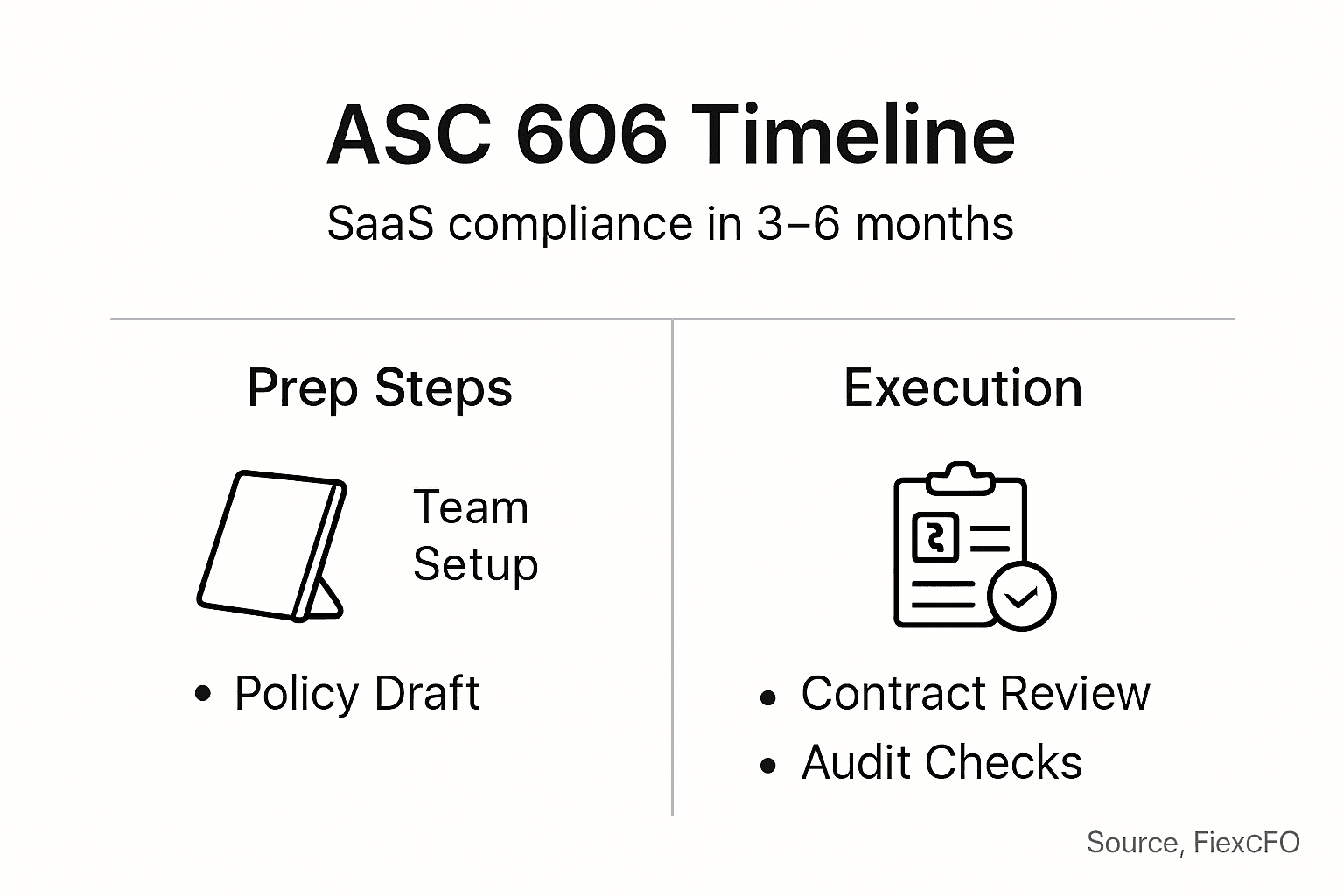
Implementation project management support accelerates timelines by providing experienced resources who have completed multiple ASC 606 implementations. The ASC 606 implementation timeline guide offers detailed project plans with phase-specific deliverables and milestones.
Tools, automation, and best practices for SaaS revenue recognition
Adopt software with dedicated ASC 606 modules to handle complex contract scenarios automatically. Modern platforms integrate with billing systems, track performance obligation satisfaction, and calculate recognition schedules without manual intervention. This automation eliminates spreadsheet errors and reduces month-end close time significantly.
Automate monthly revenue recognition and deferred revenue tracking to reduce errors and improve consistency. Manual processes break down as contract volume grows and deal structures diversify. Automation ensures every contract follows the same recognition logic and creates complete audit trails for external review.
Update recognition policies annually or with significant contract changes to maintain alignment with business operations. Schedule formal policy reviews after launching new products, changing pricing models, or expanding into new markets. Document policy changes and communicate them across finance, sales, and legal teams.
Regular internal and external audits verify ongoing compliance and catch issues early. Quarterly internal reviews examine recent contracts, test recognition calculations, and validate system configurations. Annual external audits provide independent validation and identify improvement opportunities.
Train finance teams continuously on evolving ASC 606 interpretations and industry best practices. Revenue recognition guidance evolves through FASB updates, SEC comments, and industry working groups. Ongoing education ensures your team applies current standards correctly.
| Capability | Basic Tools | Enterprise Platforms |
|---|---|---|
| Contract management | Manual spreadsheets | Automated contract repository with workflow |
| Recognition calculation | Excel formulas | Rules engine with automated scheduling |
| Deferred revenue tracking | Manual journal entries | Real-time automated tracking and reporting |
| Audit trail | File folders | Complete electronic audit trail with version control |
| Integration | Manual data entry | Direct integration with billing and ERP systems |
| Cost | Low upfront, high ongoing effort | Higher upfront, lower ongoing costs |
Pro Tip: Start with your billing system when evaluating revenue recognition automation. Many modern billing platforms include ASC 606 compliant recognition modules. Leveraging existing systems reduces implementation complexity and ensures seamless data flow from contract to recognition.
Automation and best practices advisory services help finance teams select appropriate tools and implement sustainable processes that scale with business growth.
Expected outcomes and success metrics for SaaS ASC 606 compliance
Zero revenue restatements or audit adjustments over 12 months indicates accurate implementation and strong ongoing controls. This outcome demonstrates that your recognition methodology, system configuration, and team processes work reliably. Investors and auditors view clean audit results as evidence of financial management competence.
Monthly close times shortened by 20-30% through automation and streamlined processes signal efficiency gains. Manual recognition calculations consume days during close cycles. Automation completes these calculations instantly, allowing finance teams to focus on analysis rather than data processing.
Clear, audit-ready reports improve investor confidence during funding rounds and board meetings. When you can explain revenue recognition methodology clearly and provide supporting documentation instantly, stakeholders trust your financial reporting. This transparency accelerates due diligence and strengthens negotiating position.
Regular documented compliance ensures readiness for external scrutiny from auditors, investors, or regulators. Maintaining current documentation, performing periodic control testing, and addressing issues proactively prevents surprises during formal reviews.
Key success metrics to track:
- Percentage of contracts with complete ASC 606 analysis documented
- Average time to complete monthly revenue recognition close
- Number of manual adjustments required per close cycle
- Audit findings and management letter comments related to revenue
- Days to respond to auditor revenue recognition inquiries
Monitoring compliance metrics helps finance leaders identify process weaknesses before they become material issues and demonstrate continuous improvement to stakeholders.
How FlexCFO supports your SaaS revenue recognition journey
Navigating ASC 606 implementation while scaling your SaaS business demands specialized expertise and dedicated resources. FlexCFO provides expert guidance on complex SaaS revenue recognition implementation, from initial assessment through ongoing compliance monitoring.

Our dedicated fractional CFOs specialize in scaling SaaS finance operations and understand the unique challenges of high-growth technology companies. We have implemented ASC 606 across dozens of SaaS businesses, handling everything from simple subscription models to complex multi-element enterprise contracts.
We support integrating revenue recognition with investor reporting and strategic finance, ensuring your recognition methodology aligns with fundraising objectives and board reporting requirements. Clean revenue recognition builds investor confidence and accelerates funding processes.
Accelerate your compliance and funding readiness with proven best practices from FlexCFO advisory and fractional CFO services. We deliver hands-on implementation support, team training, and ongoing advisory to keep your revenue recognition accurate and audit-ready as your business scales.
FAQ
What are the five steps in ASC 606 revenue recognition for SaaS?
Identify the contract, identify performance obligations, determine transaction price, allocate price to obligations, and recognize revenue as obligations are satisfied. For SaaS subscriptions, recognition typically occurs ratably over the contract period. Implementation services may recognize at completion.
How long does it typically take to implement ASC 606 in a growing SaaS company?
Typically three to six months with coordinated cross-functional effort and appropriate automation tools. The timeline varies based on contract complexity, existing systems, and team bandwidth. Simple subscription businesses reach compliance faster than companies with complex multi-element contracts.
What common mistakes should SaaS CFOs avoid in implementing revenue recognition?
Avoid misidentifying performance obligations, making improper deferrals, and ignoring contract modifications. Treating distinct obligations as bundled or recognizing multi-year contracts upfront creates compliance violations. Regular policy updates and automated recognition processes help prevent these issues.
Can revenue recognition be automated for SaaS companies under ASC 606?
Yes, specialized software platforms support ASC 606 automation for accurate, timely recognition and deferred revenue tracking. Modern tools integrate with billing systems, apply recognition rules automatically, and maintain complete audit trails. Automation reduces errors and shortens monthly close cycles significantly.